
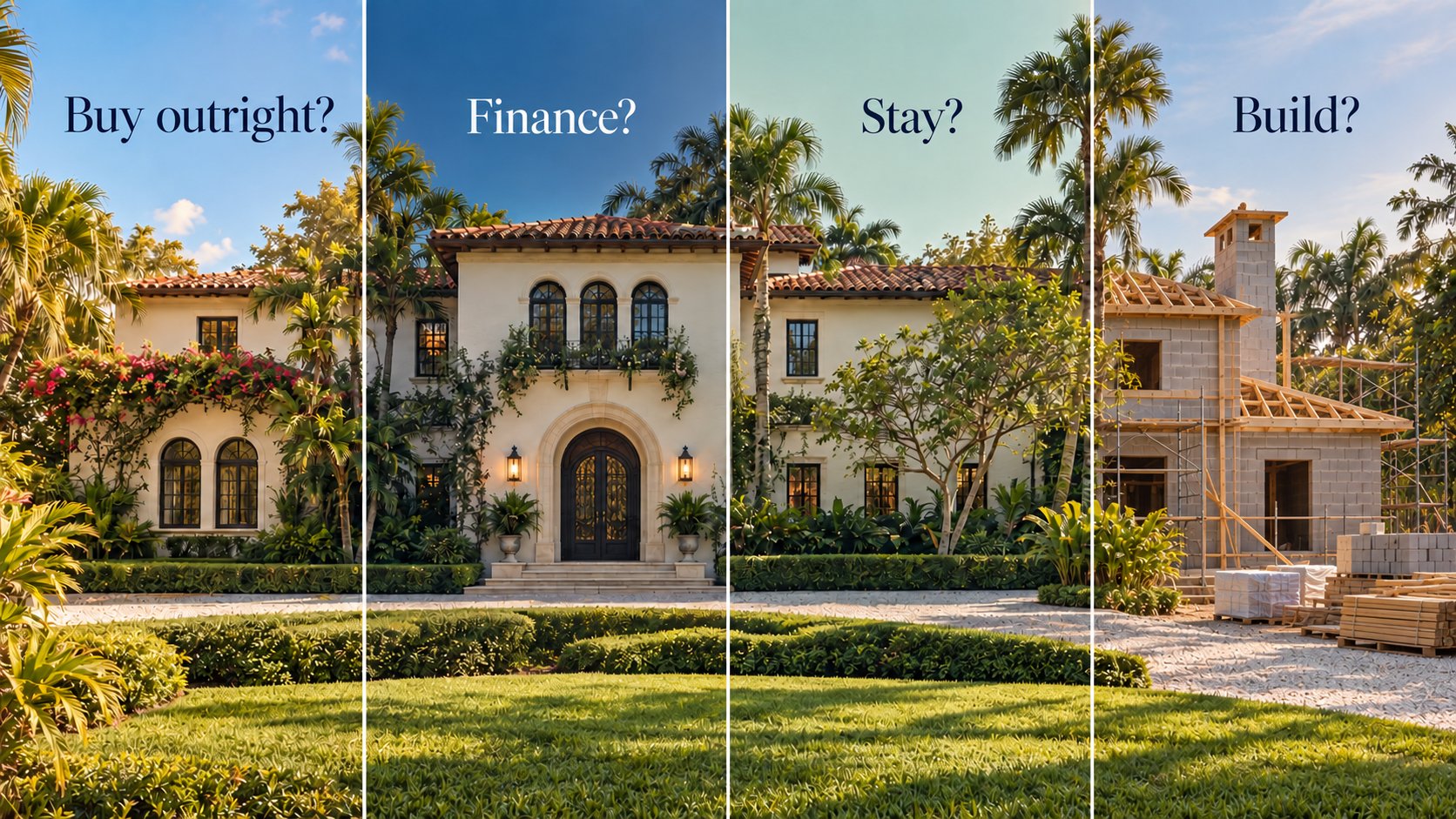
If the Miami housing market feels difficult to define right now, there's a reason. Not every buyer or homeowner is experiencing the same market.
A cash buyer looking for a home in Coconut Grove may barely consider mortgage rates. A financed buyer purchasing in South Miami may build the entire decision around the monthly payment. A homeowner in Coral Gables with a mortgage around 3% may be reluctant to sell at all. And a builder selling new construction may be able to offer financing incentives unavailable in a traditional resale.
All four are participating in the same Miami real estate market. But financially, they're playing four very different games.
Understanding which group you fall into can be more useful than trying to decide whether Miami is simply a “buyer’s market” or a “seller’s market.”
1. The Cash Buyer
Cash buyers experience today's real estate market differently because mortgage rates do not directly determine their monthly housing cost. That distinction can be particularly important in Miami's luxury markets, including Coconut Grove, Coral Gables, Miami Beach and Key Biscayne.
Cash buyers still consider the opportunity cost of their money. They may compare real estate with other investments and evaluate whether a property's value justifies tying up capital. But their ability to buy isn't dependent upon mortgage affordability.
For the right Miami property, scarcity can become more important than financing. A buyer evaluating a common property may decide to wait. A buyer considering a rare waterfront home, unusual lot, architectural property or highly desirable location may instead ask:
When will another one become available?
What cash buyers should consider
Cash can make an offer stronger and give a buyer greater flexibility, but it shouldn't replace careful valuation.
Cash buyers should still evaluate:
- Comparable sales
- Available competing properties
- Property condition
- Long-term resale potential
- How difficult the property would be to replace
2. The Financed Buyer
The financed buyer experiences the same housing market very differently. Mortgage rates directly influence monthly payments and purchasing power. A buyer putting 20% down may therefore be considerably more sensitive to changes in borrowing costs than a cash buyer looking at the same property.
But financing conditions also affect competition. When borrowing becomes more expensive, some buyers reduce their budgets or leave the market temporarily. For buyers who remain active, that can sometimes create more room to negotiate.
What financed buyers should consider
Financed buyers should evaluate the entire transaction rather than focusing only on the asking price.
That includes:
- Purchase price
- Down payment
- Mortgage rate
- Monthly payment
- Potential seller credits
- Closing costs
- Property taxes
- Homeowners insurance
- Flood insurance where applicable
- HOA or condominium fees
A lower purchase price does not always create the lowest overall housing cost. In some situations, negotiating a seller contribution or financing incentive may have a greater impact on monthly affordability.
3. The Homeowner With a Low Mortgage Rate
Another major participant in today's housing market is the homeowner who already has a mortgage around 3%. For these owners, moving can mean replacing a very inexpensive loan with significantly more expensive financing.
That can discourage homeowners from selling even when they would otherwise prefer a different property. Instead, some owners decide to renovate, expand their current home or postpone moving.
This dynamic can reduce the number of desirable homes available for sale. It also helps explain why Miami buyers may see more listings overall while still struggling to find properties that meet their specific criteria.
Should a homeowner give up a 3% mortgage?
There isn't one correct answer. A homeowner considering a move should calculate:
- Current home equity
- Expected proceeds from selling
- New monthly housing cost
- Cost of renovating the existing home
- Expected length of ownership in the next property
- Lifestyle reasons for moving
Keeping a low mortgage can be financially attractive. But the mortgage rate should not be the only factor determining where someone lives.
4. The Builder
Builders operate under a different set of incentives than traditional homeowners. A developer is carrying inventory and may have construction financing, operating expenses and additional phases of a project to consider.
As a result, builders can sometimes offer incentives that resale sellers cannot. These may include:
- Mortgage-rate buydowns
- Closing-cost contributions
- Upgrade allowances
- Preferred-lender incentives
- Special financing packages
This can make new construction more difficult to compare directly with resale properties.
Don't compare only the asking prices
Imagine a resale property priced at $950,000 and a new-construction property priced at $1 million. The resale appears less expensive. But if the builder is offering financing incentives that materially reduce the buyer's cost, the real economics of the two transactions may look very different.
Buyers should compare the full deal rather than only the listing price.
Why One Miami Housing Market Doesn't Exist
The four-player concept becomes even more important in Miami because local housing conditions vary dramatically.
A Coconut Grove single-family home isn't competing in the same market as a Brickell condominium. A Coral Gables waterfront home is not necessarily competing with a non-waterfront home nearby. A newly renovated property may attract a completely different buyer from one requiring substantial work. And a property with several nearly identical alternatives will behave differently from something genuinely rare.
That's why Miami real estate needs to be analyzed at a much more local level. National data provides context. Miami-Dade data provides more context. Neighborhood data gets closer. But ultimately, the property itself matters.
What Should Miami Buyers Ask?
Instead of asking: “Is now a good time to buy?”
Consider asking:
What am I buying?
Is the property common or difficult to replace?
How am I financing it?
Cash and financed buyers operate under very different economics.
How much competition exists?
Are there ten realistic alternatives or none?
How motivated is the seller?
A seller who needs to move behaves differently from someone who can wait indefinitely.
What leverage do I have?
Price is only one part of a negotiation.
What happens if I wait?
Rates may change, but prices, inventory and the availability of the specific property can change too.
What Should Miami Sellers Ask?
Sellers should approach the market with the same level of specificity.
- Who is the likely buyer for the property?
- Are they likely to pay cash or finance?
- What other homes are competing for that buyer?
- Is new construction offering incentives nearby?
- How easy would it be for the buyer to replace this property?
The answers should influence pricing, marketing and negotiation strategy.
The Bottom Line
There isn't one housing market right now. There is a cash buyer's market. A financed buyer's market. A market for homeowners locked into very low mortgage rates. And a new-construction market where builders have their own tools and incentives.
And within Miami, each of those markets breaks down even further by neighborhood, property type, price and inventory. That's why broad statements such as “it's a buyer's market” or “it's a seller's market” rarely tell the whole story.
The more useful question is:
Which market are you in?
Once you understand that, you can determine how to operate within it.
Watch the video above for a closer look at the four housing markets, why each requires a different strategy, and what that means for your next move in Miami.
Guillermo Freixas
MY BLOCK | SERHANT.